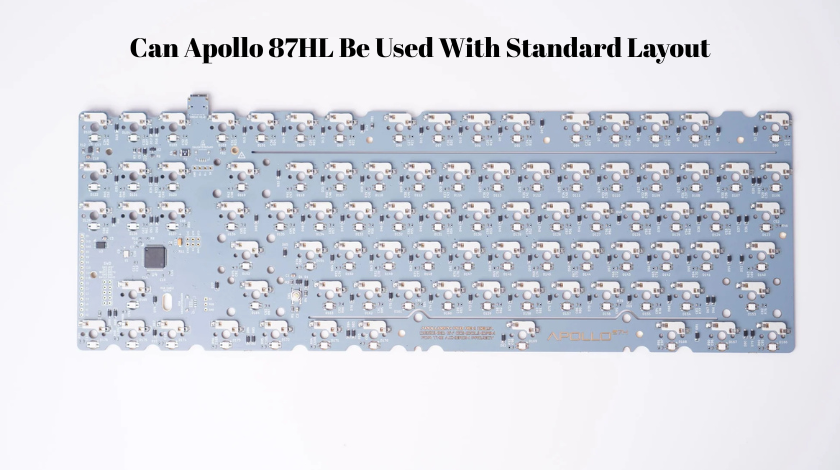

The short answer is yes. The Apollo 87HL PCB supports a standard ANSI TKL (87-key) layout, provided you choose the correct version and compatible plate. Current manufacturer specifications list the 87HL 6.25u variant as a standard F12 tenkeyless layout, while a separate 87HL-T-SC 7u version is available for enthusiasts who prefer a Tsangan bottom row.
What Is the Apollo 87HL?
The Apollo 87HL is a premium hot-swappable TKL PCB designed for custom mechanical keyboard enthusiasts. It supports:
- QMK firmware
- VIA configuration
- MX-compatible switches
- Hot-swap sockets
- Multiple layout options depending on the PCB version
Unlike many budget PCBs, Apollo 87HL is designed primarily for high-end custom keyboards such as compatible Geon F1-8X and Frog TKL builds.
Does It Support a Standard Layout?
Yes.
According to the latest specifications, the 87HL 6.25u version is specifically intended for a standard ANSI TKL layout.
That means you get:
| Feature | Standard Layout Support |
|---|---|
| ANSI TKL | ✅ Yes |
| 6.25u Spacebar | ✅ Yes |
| Standard Ctrl/Alt/Win keys | ✅ Yes |
| Standard 87-key layout | ✅ Yes |
| Hot-swap | ✅ Yes |
If you’re coming from keyboards made by brands like Keychron, Logitech, Corsair, or SteelSeries, the typing experience will feel familiar.
Which Version Should You Buy?
Apollo comes in several versions.
| Version | Layout |
|---|---|
| 87H | Standard ANSI |
| 87HL 6.25u | Standard ANSI (recommended) |
| 87HL-T-SC | Tsangan (7u spacebar) |
| 88H | F13 layout |
If your goal is a conventional keyboard, choose the 87HL 6.25u model rather than the Tsangan version.
Keycap Compatibility
Using the standard layout means you can install almost any mainstream keycap set.
You’ll have compatibility with:
- GMK
- ePBT
- PBTfans
- NicePBT
- Cherry-profile sets
- OEM-profile sets
You won’t need unusual 7u spacebars or uncommon modifier sizes.
Plate Compatibility Matters
Although the PCB supports the standard layout, you also need a matching ANSI plate.
The plate determines:
- switch positioning
- stabilizer placement
- spacebar size
- bottom-row compatibility
A Tsangan plate cannot be used for a standard 6.25u layout.
Firmware Support
Apollo 87HL supports:
- QMK
- VIA
This allows easy key remapping without changing the physical layout.
Even if you keep the standard ANSI arrangement, you can customize:
- media keys
- macros
- layers
- shortcuts
without affecting the keyboard’s physical layout.
Compatible Cases
Manufacturer documentation currently lists compatibility with:
- Geon F1-8X WK
- Geon FROG TKL WK
- Other supported Apollo-compatible TKL cases
Always verify your case supports the exact Apollo PCB revision before purchasing.
Advantages of Using the Standard Layout
Choosing the standard layout offers several benefits:
- Easier keycap shopping
- Familiar typing experience
- Better software compatibility
- No relearning of key positions
- Greater resale value
- Wider community support
For most users, there is little downside unless they specifically want a Tsangan or other custom bottom row.
Common Misconceptions About the Apollo 87HL
One of the biggest misconceptions is that the “HL” designation means the PCB only supports a non-standard layout. In reality, the layout depends on the specific PCB variant and the plate you pair with it, not simply the product name. Many custom keyboard enthusiasts mistakenly assume that every Apollo 87HL is designed exclusively for a Tsangan or split-bottom-row configuration because premium custom PCBs often prioritize enthusiast layouts. The latest product specifications, however, show that the 87HL 6.25u model is intended for a standard ANSI bottom row, making it suitable for users who want a familiar typing experience without sacrificing premium features. This flexibility is one of the reasons the Apollo series has become popular among custom keyboard builders.
Another misunderstanding involves hot-swappable sockets. Some builders believe that because a PCB is hot-swappable, it automatically supports every possible layout. Hot-swap sockets only determine whether switches can be installed without soldering; they do not change the physical switch positions or stabilizer locations. Those positions are fixed by the PCB design and the mounting plate. Choosing the correct PCB version, compatible plate, and matching keycap set remains essential for achieving a standard layout.
Building a Standard ANSI TKL with the Apollo 87HL
If your goal is to build a traditional tenkeyless keyboard, the process is relatively straightforward. Start by selecting the Apollo 87HL 6.25u PCB, which is designed around the standard ANSI bottom row. Next, choose an ANSI-compatible plate that supports the same switch and stabilizer positions. Using a mismatched plate can prevent switches from fitting correctly or leave stabilizers in the wrong locations.
Once the PCB and plate are selected, install PCB-mounted stabilizers, insert your preferred MX-compatible switches into the hot-swap sockets, and mount the assembly into a compatible case. Because the PCB supports QMK and VIA, you can immediately customize key mappings, media controls, macros, and function layers after assembling the keyboard. The result is a premium custom TKL that looks and feels like a conventional keyboard while offering significantly more flexibility than most prebuilt models.
Should You Choose the Standard or Tsangan Layout?
The answer depends entirely on your preferences.
A standard ANSI layout is ideal if you:
- Already own standard keycap sets.
- Want maximum compatibility with aftermarket accessories.
- Prefer a familiar typing experience.
- Intend to sell or upgrade the keyboard later.
A Tsangan layout may be better if you:
- Enjoy experimenting with custom keyboard layouts.
- Already own 7u-compatible keycap sets.
- Prefer the aesthetics of a wider spacebar and symmetrical modifiers.
- Frequently build enthusiast-grade keyboards.
For most users, especially first-time custom keyboard builders, the standard 6.25u ANSI layout is the simplest and most versatile choice. It offers the broadest compatibility with keycaps, plates, and accessories while retaining all the premium features that make the Apollo 87HL an attractive PCB for custom mechanical keyboard projects.
Troubleshooting Standard Layout Compatibility
Even when using the correct Apollo 87HL 6.25u PCB, builders can occasionally encounter compatibility issues during assembly. Most of these problems are not caused by the PCB itself but by mismatched components. Before installing switches, it’s worth confirming that your case, plate, stabilizers, and keycap set are all designed for the same ANSI TKL configuration. Spending a few extra minutes checking compatibility can save hours of disassembly later.
Here are some common issues and their likely causes:
| Issue | Possible Cause | Recommended Solution |
|---|---|---|
| Spacebar doesn’t fit | Using a 7u plate or keycap | Install a 6.25u spacebar and compatible ANSI plate |
| Stabilizers don’t align | Incorrect plate or stabilizer type | Use PCB-compatible stabilizers designed for the Apollo PCB |
| Some switches won’t seat properly | Plate and PCB layout mismatch | Verify both components support the same ANSI layout |
| Bottom-row keycaps don’t fit | Wrong keycap kit | Purchase a standard ANSI TKL keycap set |
| VIA doesn’t recognize the keyboard | Firmware not flashed correctly | Update or flash the latest compatible firmware |
Most assembly problems stem from mixing parts intended for different layouts rather than from defects in the PCB.
Best Switches for a Standard Apollo 87HL Build
Since the Apollo 87HL uses MX-compatible hot-swap sockets, you have access to a vast selection of mechanical switches. Your choice depends largely on your typing preferences.
Linear Switches
Linear switches are smooth from top to bottom without tactile bumps. They are popular among gamers because they provide consistent keystrokes and quick actuation.
Popular options include:
- Gateron Oil King
- Cherry MX Red
- HMX Hyacinth
- Gateron CJ
- Vertex V One
Tactile Switches
Tactile switches provide a noticeable bump during each keypress, giving feedback that many typists enjoy.
Well-known choices include:
- Boba U4T
- Gateron Baby Kangaroo
- Cherry MX Brown
- Durock Medium Tactile
- Tecsee Purple Panda
Clicky Switches
Clicky switches add both tactile feedback and an audible click. While they are satisfying for some users, they may not be suitable in shared workspaces.
Popular examples include:
- Cherry MX Blue
- Kailh Box White
- Kailh Box Jade
Because the PCB is hot-swappable, changing switches later requires no soldering, making experimentation easy.
Long-Term Benefits of Choosing the Standard Layout
One reason many enthusiasts continue to build standard ANSI keyboards is long-term flexibility. The custom keyboard hobby evolves rapidly, with new switches, stabilizers, plates, and keycap sets released throughout the year. A standard layout ensures your keyboard remains compatible with the widest range of future upgrades.
Replacement keycaps are also much easier to source. Whether you’re interested in Cherry profile, OEM, MT3, DCX, or PBT keycap sets, nearly every manufacturer includes a standard ANSI TKL kit. In contrast, specialty layouts often require additional extension kits that increase the overall cost of a build.
Maintenance is equally straightforward. If a stabilizer wears out, a switch becomes faulty, or you simply want to refresh the appearance of your keyboard, replacement parts are widely available. This convenience makes the standard layout particularly attractive for users who plan to keep their keyboard for many years while gradually upgrading individual components.
Final Thoughts
The Apollo 87HL successfully combines enthusiast-grade engineering with the convenience of a familiar keyboard layout. By selecting the 87HL 6.25u variant and pairing it with a compatible ANSI plate and case, you can build a fully standard tenkeyless keyboard without sacrificing premium features such as hot-swap support, QMK/VIA programmability, and excellent customization potential.
For newcomers to custom mechanical keyboards, the standard ANSI layout offers the smoothest entry into the hobby. Experienced builders also benefit from its exceptional compatibility with aftermarket parts and accessories. As long as you verify that your PCB, plate, case, and keycaps are all designed for the same configuration, the Apollo 87HL provides an excellent foundation for a reliable, high-performance custom TKL keyboard.