
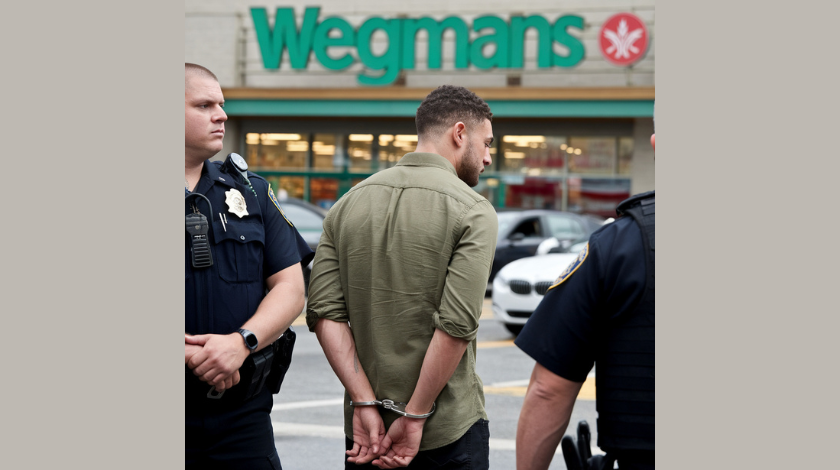

A violent altercation inside a Wegmans grocery store in Penfield, New York, led to the arrest of Tyshaun Radcliffe, drawing widespread attention from local media and community members. According to the Monroe County Sheriff’s Office, the incident began as a confrontation between two individuals near the store’s checkout area before escalating into violence. Authorities allege that one person suffered a facial injury caused by a sharp object during the fight. The victim later sought medical treatment, and investigators launched an inquiry that ultimately resulted in Radcliffe’s arrest several weeks after the incident.
Cases like this often generate significant public interest because they occur in places people generally associate with everyday routines rather than violent crime. Grocery stores serve thousands of customers each day, making incidents of violence especially alarming. As investigators gathered surveillance footage and worked with store security personnel, they pieced together the circumstances surrounding the altercation. The case has also prompted broader conversations about safety in retail environments and the importance of rapid law enforcement response when serious assaults occur in public settings.
The Incident at Penfield Wegmans
When and Where the Fight Occurred
The altercation occurred on February 24, 2026, inside the Wegmans located on Penfield Road in Penfield, New York. According to investigators, the confrontation happened near the store’s cash registers during the afternoon while customers and employees were present. Witnesses reported that the dispute escalated quickly, creating concern among shoppers before both individuals left the store. Authorities later confirmed that the injured individual made it to a nearby workplace before seeking hospital treatment for injuries described as non-life-threatening.
Violent incidents inside busy retail stores remain relatively uncommon, but they pose unique challenges for law enforcement because they often occur in crowded environments with numerous witnesses. Surveillance cameras, employee observations, and customer statements frequently become critical evidence during investigations. In this case, investigators relied on multiple sources of evidence to reconstruct what happened and identify the suspect involved in the assault. The availability of modern surveillance technology helped authorities move the investigation forward after the initial incident had concluded.
How the Altercation Escalated
Investigators allege that the confrontation escalated when the victim was cut in the face with what authorities described as a sharp instrument. While officials have not publicly detailed the events leading to the argument, they stated that the injury occurred during the fight itself. The victim survived and received medical treatment, with officials indicating the injuries were not life-threatening. After collecting witness statements and reviewing available evidence, investigators continued working for several weeks before making an arrest.
According to reports, the investigation involved cooperation between the Monroe County Sheriff’s Office, Wegmans security personnel, and New York State parole officials. This collaborative effort enabled investigators to identify the suspect and secure sufficient evidence before filing criminal charges. Law enforcement agencies frequently take this approach in complex investigations, particularly when reviewing surveillance footage and verifying witness accounts.
Who Is Tyshaun Radcliffe?
Public information released by investigators identifies Tyshaun Radcliffe, age 28, as the individual arrested in connection with the Penfield Wegmans incident. According to the Monroe County Sheriff’s Office, Radcliffe was taken into custody after investigators reviewed surveillance footage, interviewed witnesses, and completed their investigation into the February altercation. Authorities have also stated that he was on parole at the time of his arrest, a detail that may have implications for separate parole proceedings in addition to the criminal case. At this stage, the information available to the public comes primarily from law enforcement announcements and court records, and the criminal case remains subject to the judicial process.
It is important to distinguish between an arrest and a conviction. An arrest indicates that law enforcement believes there is probable cause to charge an individual with a crime, but it does not establish guilt. Under the U.S. legal system, every defendant is presumed innocent unless and until proven guilty in court or through a guilty plea. As the case proceeds, prosecutors will present evidence supporting the charges, while the defense will have the opportunity to challenge that evidence and present its own arguments. This legal framework exists to ensure fairness and due process regardless of the seriousness of the allegations.
Information Released by Authorities
Officials have indicated that the investigation relied on several forms of evidence, including store surveillance video, witness interviews, and information gathered after the victim sought medical treatment. Investigators allege that the evidence linked Radcliffe to the assault that occurred inside the grocery store. Law enforcement has not publicly released every detail of the investigation, as is common in active criminal cases, but the information disclosed was considered sufficient to support the charges filed against him.
Authorities have also emphasized that the incident appears to have involved a dispute between specific individuals rather than a random attack on shoppers. While that distinction may reassure some members of the public, it does not lessen the seriousness of violence occurring inside a busy retail environment. Incidents of this nature can create panic among customers and employees alike, disrupt business operations, and require a coordinated response from store personnel, emergency medical services, and law enforcement.
Arrest and Criminal Charges
Following the investigation, authorities arrested Tyshaun Radcliffe and charged him with several offenses related to the alleged assault. The charges announced by investigators include second-degree assault and criminal possession of a weapon, reflecting the allegation that a sharp instrument was used during the altercation. The specific wording and classification of criminal charges are determined under New York law and are based on the facts investigators believe they can prove in court.
Criminal charges are formal accusations, not findings of guilt. Prosecutors must still establish every element of each offense beyond a reasonable doubt during the court process. The defense has the opportunity to challenge witness testimony, question physical evidence, and present any lawful defenses available. As with any criminal matter, the outcome will ultimately depend on the evidence presented before the court.
Assault Charge
Under New York law, second-degree assault is generally considered a felony offense and can apply when an individual is alleged to have intentionally caused physical injury using a dangerous instrument or under other circumstances defined by statute. According to investigators, the victim sustained a facial injury requiring medical treatment. Although officials described the injuries as non-life-threatening, the alleged use of a sharp object elevated the seriousness of the incident and contributed to the felony charge.
Cases involving alleged assaults in public locations often attract considerable attention because they affect not only those directly involved but also bystanders who witness the violence. Prosecutors typically rely on a combination of medical records, surveillance footage, eyewitness testimony, and physical evidence when presenting such cases in court. The availability of multiple forms of evidence can help establish a timeline of events, though each piece of evidence remains subject to examination during legal proceedings.
Criminal Possession of a Weapon
Investigators also charged Radcliffe with criminal possession of a weapon in connection with the incident. Authorities have not publicly disclosed every detail regarding the object allegedly involved, referring to it as a sharp instrument in public statements. Determining whether an object legally qualifies as a weapon often depends on how it was allegedly used and the surrounding circumstances, rather than solely on the object’s ordinary purpose.
Weapon-related charges frequently accompany assault cases when prosecutors allege that an object capable of causing serious physical injury was used during the commission of an offense. As the case advances, additional details may emerge through court filings, hearings, or evidence introduced during trial. Until then, many aspects remain allegations that have yet to be tested in court.
Investigation Details
The investigation extended beyond the day of the incident and involved cooperation between several agencies. Detectives gathered surveillance recordings from inside the Wegmans store, interviewed witnesses, and reviewed medical information relating to the victim’s injuries. These investigative steps are common in cases involving alleged violent offenses because they help establish both the sequence of events and the identities of those involved.
Retail stores today often maintain extensive security systems that capture activity from multiple angles. Combined with eyewitness accounts and physical evidence, surveillance footage can provide investigators with a clearer understanding of what occurred before, during, and after an incident. While video evidence can be highly valuable, it is typically evaluated alongside other forms of evidence rather than viewed in isolation.
Sheriff’s Office Response
The Monroe County Sheriff’s Office led the criminal investigation and later announced the arrest after completing its review of the available evidence. Investigators credited the work of detectives and cooperating agencies in identifying the suspect and developing the case. Law enforcement officials routinely remind the public that investigations continue even after an arrest, particularly when prosecutors request additional evidence before trial.
Officials also encourage witnesses to cooperate with investigations whenever violent crimes occur in public places. Statements from customers, employees, and others present during an incident can help clarify disputed facts and corroborate other evidence collected during the investigation. Such cooperation often plays an important role in ensuring that cases proceed through the justice system based on the fullest possible understanding of the events.
Role of Wegmans Security
Large grocery chains such as Wegmans generally maintain comprehensive security measures that include surveillance cameras, trained staff, and procedures for responding to emergencies. Although company representatives have not publicly discussed every aspect of this specific incident, retail security personnel commonly assist law enforcement by preserving surveillance recordings, documenting events, and coordinating with responding officers.
Security systems cannot prevent every confrontation, but they often provide valuable evidence after an incident occurs. High-quality surveillance footage may assist investigators in identifying individuals, verifying timelines, and determining how events unfolded. Businesses also regularly review significant incidents internally to evaluate whether additional safety measures or procedural changes may be appropriate.